8382 N. Wayne Drive Suite 202 Hayden, ID 83835


Maintaining a perfectly straight smile for a lifetime is a much bigger challenge than most people realize during their teenage years. It’s a common story in our office: a patient spent two or three years in metal brackets and wires a decade ago, only to notice that their lower front teeth are crowding again or that a small gap has reopened. This movement is called orthodontic relapse. It often happens because the ligaments holding your teeth in place have a sort of “memory” and naturally try to pull teeth back toward their original, crooked positions.
According to a study published in the American Journal of Orthodontics and Dentofacial Orthopedics, a significant percentage of patients experience some degree of dental crowding in the decades following treatment. Usually, this is the result of not wearing a retainer as instructed. Life gets busy, retainers get lost during a move, or they simply stop fitting comfortably, and we assume the teeth will stay put on their own. Unfortunately, teeth are dynamic; they respond to the constant pressure of chewing, speaking, and even the natural aging process of the jawbone.
Taking action early when you notice these subtle shifts is the best way to prevent a minor issue from becoming a major misalignment. Patients want a solution that fits their current lifestyle without drawing unnecessary attention to their teeth.
Returning to Treatment with Clear Aligners
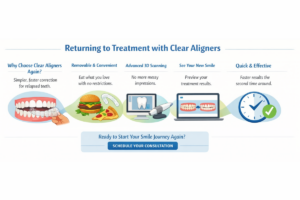
Choosing a second round of orthodontic work is a decision rooted in both health and self-confidence. If you are researching your options, you might be pleased to find that clear aligner therapy is often more effective the second time around than it was for your initial treatment. Since your roots were already moved once, the corrections needed for relapse are often much simpler and faster than starting from scratch.
A primary reason patients ask about Invisalign in Hayden is its convenience. Unlike the permanent oral appliances of your youth, these aligners are removable. This means you can keep eating your favorite local Northwest cuisine without worrying about breaking a bracket or getting food stuck in wires. The technology behind the plastic has evolved significantly, enabling precise, predictable movements that target only the teeth that have shifted, rather than moving the entire arch if unnecessary.
The process begins with a digital scan of your mouth—no more biting into those messy, goopy trays that made everyone gag back in the day. This scan allows us to create a 3D roadmap of your treatment. We can literally show you a digital “movie” of how your teeth will move from their current position back into that perfect alignment you remember from the day your braces were first removed.
Is Your Relapse Simple or Complex?
Before we decide on a specific path, we have to assess the severity of the shift. Not every “second-timer” has the same needs. Some people have “minor crowding,” where the teeth are slightly overlapping at the bottom. Others might have developed a “bite issue,” in which the upper and lower teeth no longer meet correctly, which can cause jaw tension or uneven enamel wear.
- Minor Relapse: This usually involves just the front six teeth. It’s mostly a cosmetic concern and can often be corrected in just a few months.
- Moderate Shifting: This might involve teeth further back in the mouth or a recurring gap (diastema).
- Bite Changes: If your teeth have moved so much that your “occlusion” or bite is off, we may need a slightly longer treatment plan to ensure you aren’t grinding your teeth at night.
The beauty of choosing Invisalign for these corrections is the level of customization. We aren’t just slapping on a generic set of trays; we are designing a sequence that respects the work you already put in years ago. It’s about refinement and protection. By correcting the alignment now, you are also making it much easier to brush and floss, which reduces your risk of gum disease and decay in tight spots where the toothbrush can’t reach.
What to Expect During the Second Time Around
Expectations are usually very different for adults than for teenagers. Most of my patients are pleasantly surprised by how much more comfortable clear aligners are compared to the “tightening” appointments they remember from traditional orthodontics. While you will feel some pressure every time you switch to a new set of trays, it is a gradual, controlled force that most people adapt to within a day or two.
Discipline is the secret ingredient here. Since the trays are removable, the temptation to leave them out for a few hours can be high. To stay on track, you need to wear them for about 22 hours a day. This gives the teeth enough “signal” to move and then hold that position. If you’re heading out to a dinner in Coeur d’Alene or a local event, you can absolutely take them out to eat and drink, but they need to go right back in after a quick rinse.
The duration of treatment is also a major talking point. Because we are often just “re-straightening” teeth rather than performing major jaw widening or complex extractions, the timeline is frequently much shorter than your first experience with braces. Many relapse cases are completed in six to twelve months, which feels like the blink of an eye compared to the years spent in metal as a kid.
Protecting Your Investment with New Habits
Once we achieve that straight smile again, the focus shifts entirely to “retention.” We want to make sure this is the last time you ever have to worry about your teeth moving. Modern retainers are much more durable and comfortable than the old-school “Hawley” retainers with the thick plastic and metal wire.
We often recommend a “fixed retainer” for the lower teeth—a tiny, thin wire bonded to the back of your teeth where no one can see it. It does the heavy lifting for you. We then pair that with a clear, removable retainer for the top. By visiting our Hayden office for Invisalign treatment, you ensure that your retention plan is as modern as your treatment plan. We view this as an insurance policy for your smile. You’ve put in the time and the financial investment; it only makes sense to guard that result with a few simple nighttime habits.
You don’t have to live with the frustration of a smile that has drifted away from its best version. Whether your teeth have shifted just a millimeter or have moved significantly, there is a straightforward, discreet way to bring them back into line. Restoring your confidence doesn’t have to mean a return to the “metal mouth” days of middle school.
FAQs
Can I get clear aligners if I still have a permanent wire from my old braces?
Yes, but the old wire will need to be removed before you start your new treatment. We can’t move teeth that are currently “locked” together by a fixed retainer. Once your new treatment is finished, we can discuss whether you want a new fixed wire or if a removable nighttime retainer is a better fit for your current hygiene routine.
Will clear aligners fix the jaw pain I’ve developed since my teeth shifted?
In many cases, yes. When teeth shift out of alignment, your bite can become “heavy” in certain areas, leading to TMJ strain or muscle tension. By realigning the teeth into a more balanced position, we can often alleviate the uneven pressure that contributes to jaw discomfort.
Are there age limits for a second round of orthodontic treatment?
Absolutely not. I have patients in their 60s and 70s seeking treatment for shifted teeth. As long as your bone structure is healthy and your gums are in good shape, your teeth can be moved at almost any age. In fact, keeping teeth straight as you age is one of the best ways to prevent tooth loss and gum recession.
Do I need to see a specialist if my relapse is only on the bottom teeth?
Even if you only see movement on the bottom, we usually treat both arches. This is because the way your top and bottom teeth “mesh” is vital. If we move only the bottom teeth, they might no longer fit correctly against the top teeth, which can cause long-term dental issues. We look at the mouth as a complete, functioning system.